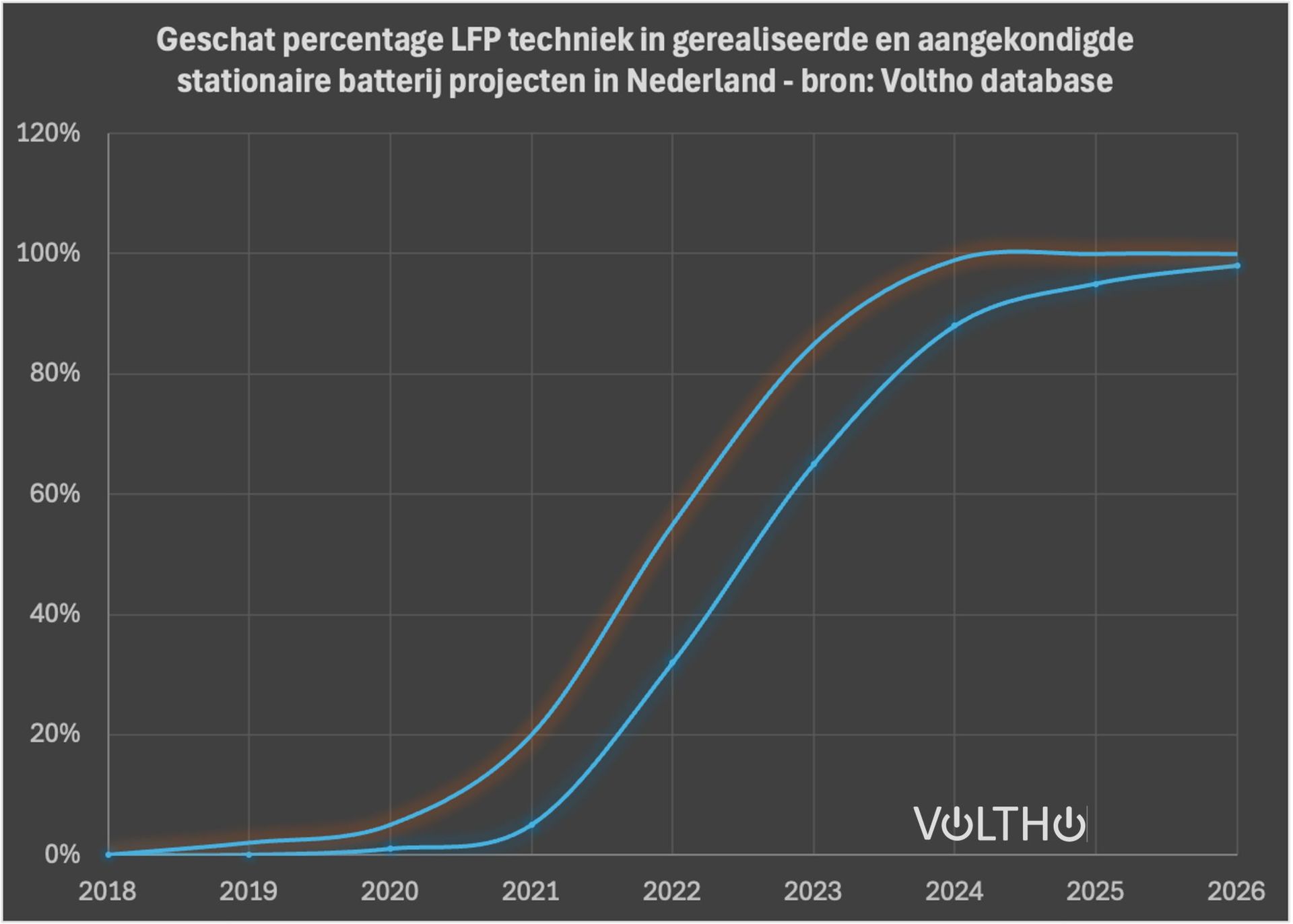
LFP is currently dominant — but sodium-ion (NFP) is clearly on the rise. It is expected that NFP will increasingly be used alongside LFP in energy storage in the coming years.
CATL expects large-scale application of NFP in EV's and stationary systems starting in 2026. The new Naxtra generation achieves around 175 Wh/kg in energy density. This is practically 10–20% below high-end LFP, but close to mainstream LFP energy density levels. Thanks to largely similar production processes with LFP, NFP can be scaled up relatively quickly. Combined with long lifespan and good performance in cold temperatures, NFP is technically well-suited for stationary storage.
Not only CATL, but also BYD, Gotion BESS and CALB Group Co., Ltd.report significant NFP plans. In Europe, the first commercial NFP application was reported at PHENOGY AG in Switzerland — where, among other things, the broader voltage range of NFP influenced the choice of inverters.
According to the International Energy Agency (IEA) battery system costs could decrease by about 40% by 2030 — partly thanks to new chemistries like NFP. It is reported that Chinese analysts (Sina Finance Global) expect that NFP cell prices will drop from 0.52 元/Wh to ~0.25 元/Wh by 2030. For comparison: LFP cells for storage are currently slightly lower. This means: no price breakthrough in 2026, but possibly from the end of 2027. And another important advantage: sodium reduces dependence on lithium prices and thus raw material risks and price speculation. If you combine this with the expectation from @SPIR (Qidian Research Institute) that NFP demand could rise to ~500–600 GWh per year for BESS by 2030, then NFP could represent a substantial part of the global storage market.
🔍 Voltho observation
In our Voltho database, we see that today over 95% of new NL-BESS projects use LFP. But the market logic for NFP is quickly becoming stronger — especially in price-sensitive grid-storage applications.
👉 Will there be a new line with NFP technology starting from the end of 2026 or in 2027 in the graph below?
👉 How will NFP influence battery projects? Inverter choice, safety, sizing, RTE, DoD, etc.?
👉 Do EPCs and financiers already have NFP in their models?
👉 Do you have access to NFP systems or pilots?
With better market insight, you will move faster and make a greater impact.
AtVolthowe help with data, market interpretation, and strategy. Send me a DM for more info.