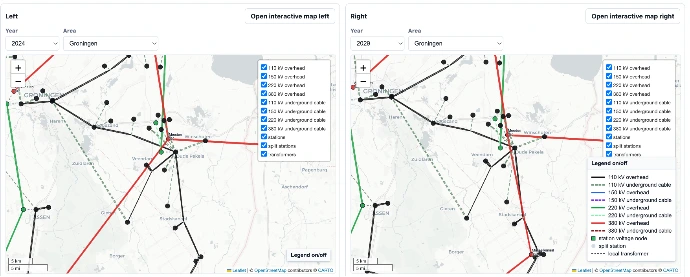
1. We continuously update our model of the electricity grid.
Existing grid topology and future grid operator projects, transformers, cables, lines and interconnectors.
2. Realised and expected installed generation, demand and flexibility are mapped.
We model electricity demand from households, businesses, industry and data centres, and generation from solar, wind and conventional power plants. We enrich this with Voltho Energy Intelligence on batteries, e-boilers, heat pumps and other flexible assets.
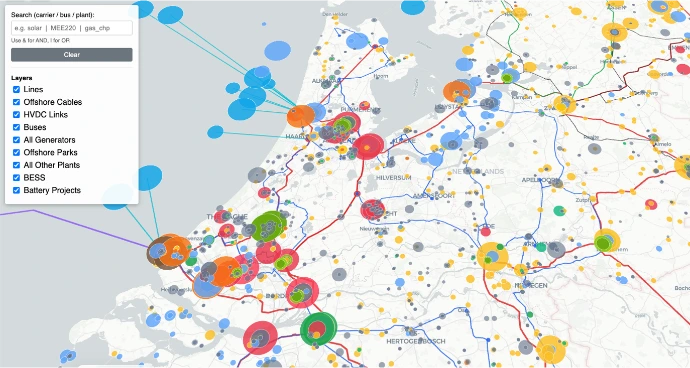
3. We simulate the electricity market with hourly supply and demand.
Hourly dispatch based on demand, generation, weather and various market scenarios. We use detailed weather models of North-West Europe based on historical or future profiles.
4. We calculate the impact on the grid
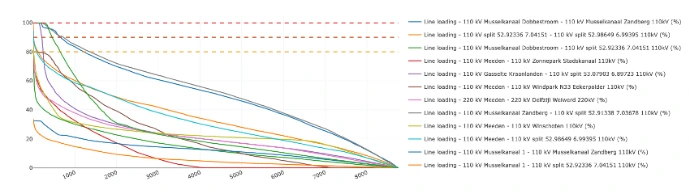
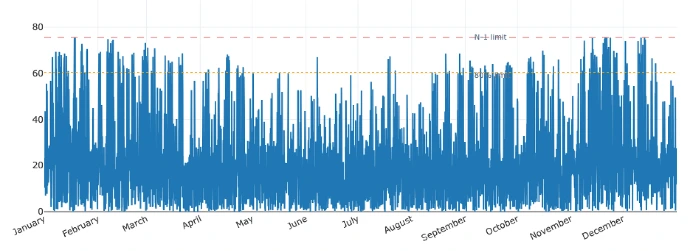
For every grid component we obtain a loading in MW per hour, taking into account the grid operator's redundancy limits. This lets us simulate when, where and for how long congestion occurs.
5. We translate this to your project
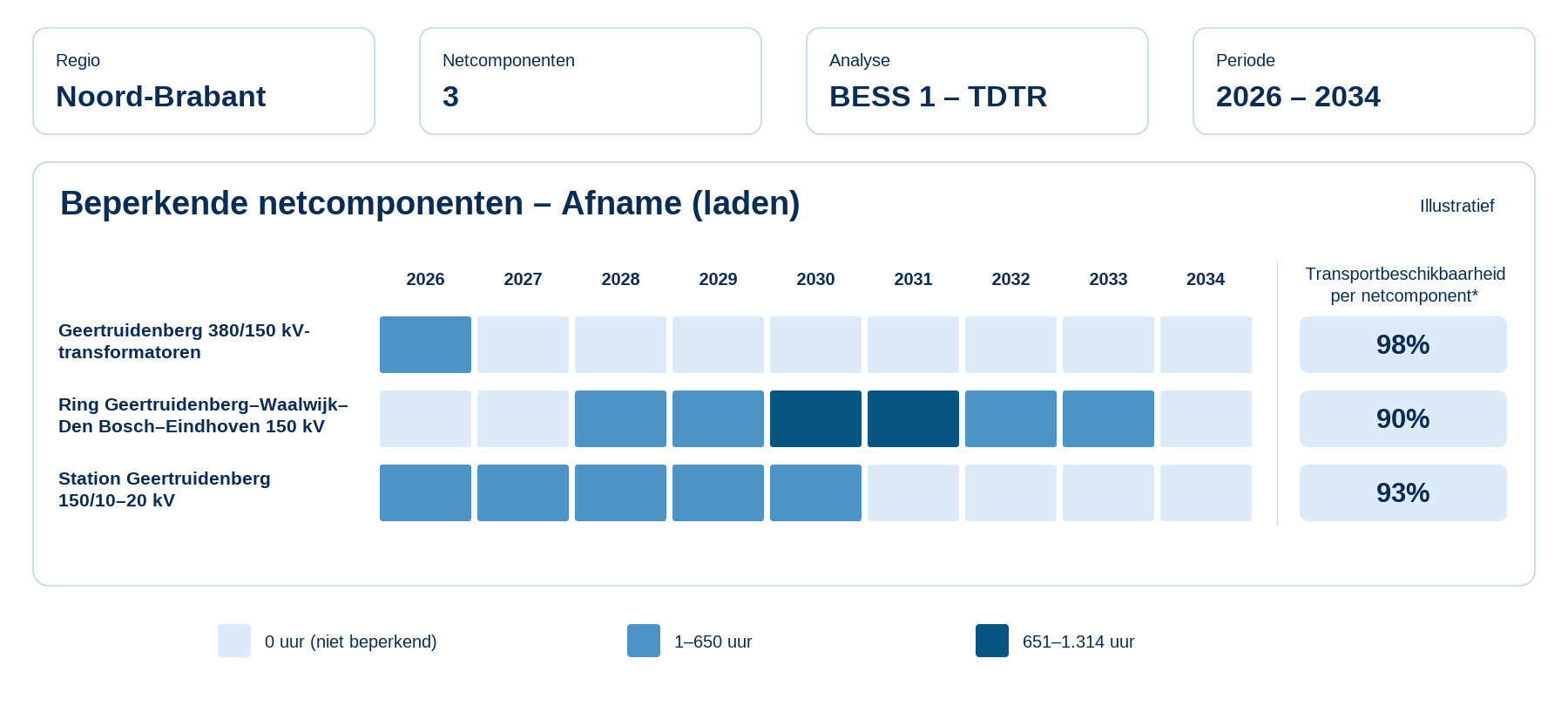
Gridflow translates the observed congestion to your project-specific objective, such as the expected available capacity per hour — for offtake and feed-in — or the potential impact on TDTR, VVTR, CSC and BPC.
This illustrative analysis shows which grid components can limit the charging capacity of BESS 1 per year, how many hours these limitations occur and what this means for the available transport capacity under a TDTR contract.
Trusted by












Want to know more about the Gridflow methodology?
Contact us today to deepen your insight